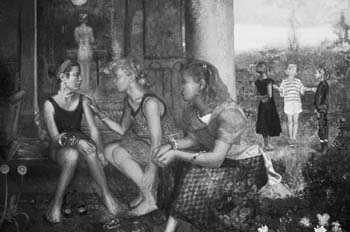
"Mythic Master: Painter Frank Galuszka constructs images of the celestial and the mundane, of excess and sacrifice, with the techniques of Renaissance masters--that is, if he chooses to. "
The description of Galuszka's work in the link above uncovers why his work is the way it is. He has Renaissance training which he uses only when he wants to. At the same time, as demonstrated quite articulately in "Junk", Galuska is "A juggler of the celestial and the mundane, of excess and sacrifice". He can depict the mundane (junk or a run-down porch in Philadelphia) as celestial (riches or a heavenly and glowing scene). Whether it is the optimist in Frank or his extensive training and life experience, he moves "confidently from mythic reason to explosive abstraction". It was mentioned in class today while discussing Weitz that a definition should be eternal, but with times changing and art in turn adapting to the world, how can a true definition be possible? Perhaps artists lie Galszka could provide an answer to this question. As Professor Johnson said, he doesn't change is environment, he changes how he is in his environment--depicting the world both as it is (and finding its beauty) and how we sometimes wish it could be. I'm not completely sure about an exact definition--including necessary and jointly sufficient conditions--for art, but surely Galuszka's ability to represent and create simultaneously while finding beauty in the mundane, must be included in the definition of a true artist.

No comments:
Post a Comment