Saturday, May 7, 2011

Motivation and 'Pure' Art

I found this image on google and wondered: Is pure art selfless art? We briefly mentioned "motivation" in class recently when discussing talent and skill. Does motivation play a part in determining the validity or value of art? If the reinforcement behind creating a piece of art is external--recognition, money, conflict, etc--does that make the artist or art object less legitimate than if the reinforcement were internal? Is art for others more valuable than art made for the artist? Is art that simply exists for the soul purpose of being art (rather than to make something else happen) more real?
----
The following are a few of my favorite quotes on art:

Creativity is allowing yourself to make mistakes. Art is knowing which ones to keep.
Dilbert, created by Scott Adams

Fairy-tales interest me as a manifestation of pure art, perhaps the very first instance of art detaching itself from real life, and also because - like pure art - they enhance reality, remaking it in their own likeness, separating good from evil, and bringing all fears and terrors to a happy conclusion.
Abran Tertz, A Voice from the Chorus.

I do not literally paint that table, but the emotion it produces upon me.
Henri Matisse

I feel that art has something to do with the achievement of stillness in the midst of chaos. A stillness which characterizes prayer too, and the eye of the storm. I think art has something to do with an arrest of attention in the midst of distraction.
Saul Bellow


I paint objects as I think them, not as I see them.
Pablo Picasso

I think that 95 percent of what passes for art in this world is complete and utter shit. And 4 of the other 5 percent is shit with an asterisk. But oh, that 1 percent makes you proud to be a human, doesn't it?
Dennis Miller

Response to Kim

How much impact do you think theory has on art?

In the article that Kim posted, Storr writes, "...even though you may share a vocabulary, you don’t share at all the same kind of generative process or goals." In response to Kim's question, I think that theory is separate from application in any field, including art, for just this reason. The process of art is creation. It is physical. The process of theorizing about art is thinking about how and why, not necessarily just the creation. Artists work to produce a product. Yes, their ultimate goal may be cognitive in that they desire an emotional reaction or thought-provoking result, but art is art is art. And theory is theory is theory. While theory does help explain art, I don't think all consumers of art consider theory. Actually, those who do consider theory are likely to be the minority. Theories change just as art does. So what is considered art in one context, in one place, at one time, may not be considered art in another. I'm not sure that art and theory will ever be parallel because of the temporal nature of both.

Thursday, May 5, 2011

Balance


"Both. I sometimes feel I am right, but do not know it. When two expeditions of scientists went to test my theory I was convinced they ... I'm enough of an artist to draw freely on my imagination, which I think is more important than knowledge. Knowledge is limited. Imagination encircles the world."—Albert Einstein

While I do believe that imagination is imperative in artistic development, talent, performance, and lifestyle, I'm not quite sure that I agree wholeheartedly with Einstein's claim. Why? I believe that imagination coexist and interact in a similar manner as the subjective and objective. They are--if you will--magnetic: opposing cognitive abilities whose polarities both repel and attract. As mentioned in Taylor's essay, Knowledge is public. Imagination is private. Imagination provides escape. Knowledge is reality. Knowledge facilities community and continuity, while imagination facilitates change. Imagination is grounded in knowledge. As Buddhists, the Chinese, and even Isaac Newton believe, balance is key. Quantity isn't necessarily best. As for art, I believe that these concepts can be applied and that imagination and knowledge are both necessary in the creative process. What does everyone else think?

Sunday, May 1, 2011

Response (Eternal Sunshine of the Spotless Mind)


In her most recent post, Gina asked in reference to the film Eternal Sunshine of the Spotless Mind, "Do you think it is safe for a procedure such as this to take place? Should science take over to force knowledge to be more important that imagination, memory, and hope that a imaginings of yesterday could become realities of today?" In response, I disagree with this particular procedure on the sole claim that as humans, we can learn from everyone and everything. It would be nice to erase painful memories or even certain people's participation in our lives so that we would shed less tears, regret less, or only react to our (happy) thoughts and memories with more happiness. But what would we learn? Without our mind's ability to substitute possibilities into past memories or future plans--creativity--would we learn anything at all? Would knowledge be of any value? I believe that every person and situation that we encounter has the potential to teach us something about ourselves and about the world. It's all just a matter of whether or not we choose to see it. Knowledge is supposed to teach us and equip us with tools for future obstacles. But I don't believe that true knowledge can exist without imagination--without the ability to think beyond what we know, hypothetically, creatively. Selective knowledge to spare our emotions (like the procedure used in Eternal Sunshine) seems like it would be robbing us of valuable knowledge and tools for emotional and personal growth. We shouldn't select what we feel or what we know. The two coincide with one another and would waiver and eventually fall without their counterpart.

What do you think?

Thursday, April 28, 2011

Creativity: Necessary and Sufficient

A complimentary video to Claxton and Taylor´s essays.

¨Many people believe that creativity is something you either have or you don't, and if you are amongst the happy few, you'll use your creativity to create difficult art the general public won't understand but your creative counterparts will love.
But; creativity is of vital importance to every act you'll ever do. Art or no art. The usage of your creativity can change every action you'll ever do from ordinary to extraordinary.¨

Saturday, April 23, 2011

Participation Art

Participation Art

The link above is an example of participation art at SFMOMA. "Visitors in the exhibition "The Art of Participation: 1950 to Now" at SFMOMA (November 8, 2008 - February 8, 2009). Looking back nearly 60 years across a wide spectrum of genres and media, this exhibition examined how artists have engaged members of the public as essential collaborators in the art-making process."

If anyone can be a part of it, how is this art "unique"?

Piper might argue that since humans are experiencing/participating in it, that is exactly WHY it is unique: no two will experience it the same way.

What do you think?

Black Swan Theory (inspired by Piper's mystery of the object)


A link to an essay on "Black Swan Theory"

When discussing Piper's view of performance art as unique, we mentioned that no two performers are the same regardless of how similar their technique is. The film "Black Swan" is about a dancer who must play two conflicting roles on stage. The roles begin to affect her waking life and the conflict eventually results in psychosis. The excerpt from Psychology Today suggests that humans naturally attribute order and predictability to every day events... "Because it is always comforting (and often useful, in fact) to believe that the world is a safe, predictable place. It feels good to be overly optimistic and to feel in control of one's destiny, and that everyone else is in control of his or her destiny. That if I do a,b, and c then x,y, and z will result. But if we take this comforting and illusory form of thinking overboard by under-representing uncertainty in our efforts to predict the future, we leave ourselves vulnerable to the jarring peck of the black swan." Perhaps this is what Piper means by the 'mystery of the object'. Objects are predictable. They have qualities that we expect to experience. Attributing magical powers and the ability to move us to objects, according to Piper, is naive. People, on the other hand, are far beyond predictable. Despite our more or less 'concrete' (or at least impeccably slowly changing) personalities, we are complex and ever-changing. Our actions often seem impulsive and illogical. Our personal creations--our ART--are symbolic and unique. Perhaps, as Piper suggests, the uniqueness of mankind is what makes performance art not only unique, but irreplaceable as well.

Tuesday, April 12, 2011

When Did This Become Art?

Although I don't agree with absolutely everything Rooney says, he makes a few good points in this video, asking "Does every space have to be filled with something?". What happened to simplicity?

Final Thoughts on Dickie

Perhaps the most blatant conclusion to be drawn from Dickie concerns his failure to objectively define art--a problem which we keep returning to. According to Dickie, it is not inherent properties, but a relational property within the artworld that makes an object art. These relational properties elicit conferred status and then an "objective definition" is possible but doesn't often emerge. Although Dickie seems confident in declaring almost ANYTHING as a candidate for appreciation as long as it has conferred status, I am not quite as comfortable in doing so. His view appears extremely inclusive and almost demoting to true art and artists, suggesting that uniqueness and merit and independent of status in a world that anyone can be a part of. I've come to realize recently that a number of theorists (on the subject of art and of other subjects) tend to use language for reasons beyond persuasion. The circularity that we have encountered in many class discussions is due largely to language rather than theory. While it is frustrating to accept our limitations as humans, I do think that it is also necessary to realize that even the greatest of thinkers can't always articulate flawless theories. Dickie, among others, writes in a manner that seems to deny failure, but in reality he is repeating himself and not getting very far. Isn't the aim of philosophy to ask more questions? Does anyone else think that we have become so focused on "What is art" and "What is art's unique value" that it is possible that we are missing other questions?...Such as, WHY is there no single answer to these questions?Maybe then, we could answer them better.

Thursday, April 7, 2011

Response to Kim

In her last post, Kim asks, How does or should Danto deal with conflicting, legitimate art theories? Arguably, Danto writes somewhat circularly and doesn't quite define art. Although Danto acknowledges that one must have knowledge of the history and theory of art in order to understand and appreciate it (a central part of his own theory), he doesn't come up with any objective standards upon which we could begin to define art. Perhaps this is because of his emphasis on value rather than physical properties; evaluation rather than description. But what frustrates me is Danto's lack of concrete examples. Theories of art are different, I acknowledge. But they must contain some common quality, otherwise I feel that Danto's "is" may be too general and too inclusive. Knowledge and history are necessary in order to understand almost anything, I agree, but they are such broad concepts that I wonder how accurate one can be while using them to define rather than evaluate. In class, we determined that sometimes it is not the object that has artistic qualities, but the language that describes it (although the object can render such qualities). While in theory, this all makes sense to me, I can't help but confess that the redundancy which occurs when discussing the value of art always seems to overshadow and distract from our unanswered (or at least more complex) question of "What is art?".

Monday, April 4, 2011

What Is, Isn't

"It is one of the commonest of mistakes to consider that the limit of our power of perception is also the limit of all there is to perceieve."-C.W. Leadbeater

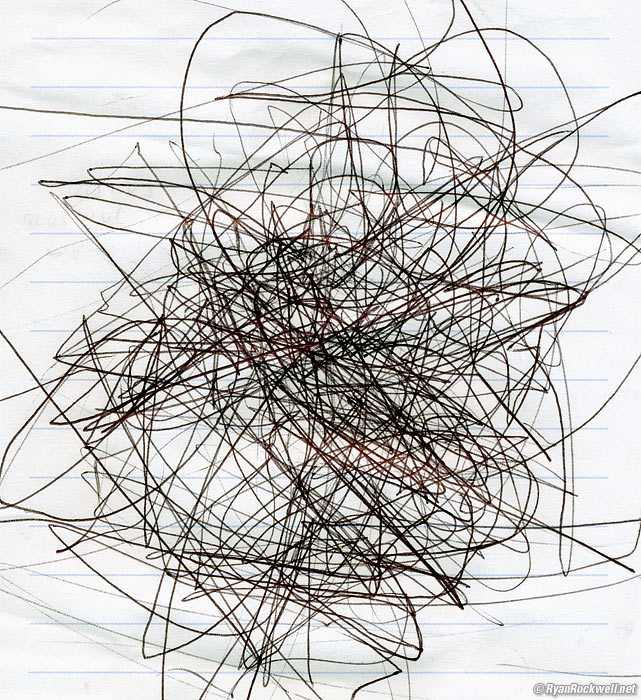
The is of artistic identification, according to Danto, is a privilege to understand. As mentioned in class today, experience is an integral part of acquiring and maintaining the ability to understand (and therefore define) art. This idea also traces back to symbolism. Without experience beyond scribbles, an individual cannot see the picture in this post as anything but scribbles. However, a viewer who has been through emotional turmoil may see it as a representation of the confusion, anger, or sadness they once experienced or as a a cathartic process geared toward personal progression and development beyond a situation or emotion. To an extent, this view is highly subjective, suggesting that a work of art could mean almost anything to anyone depending on their past experience. With deeper consideration, however, I wonder if the above quote can be applied. Does every piece of art have the ability to elicit many perceptions based on the viewer? Can art encompass multiple qualities, some of which can only be seen by the "educated", "experienced" or perceptually aware? Is the is of artistic identification a set point? Or is it what it is to who is experiencing it?

Saturday, April 2, 2011

Response to Gina's post (Dewey's Dinnerware)

In Gina's most recent post, she poses a question: "Likely all would agree that the fancy tableware is art while on display on the shelf or in the cabinet, but does it decline in artistic stance when it gains in practical (yet still just as artistically beautiful for, the piece itself doesn't change) importance while presenting food upon the table?" This question reiterates focus on the intentionality theory. As I would normally argue with Goodman that "when" art occurs is the most important aspect when considering objects, I feel that many found artifacts, "fancy" dinnerware, or handcrafted furniture could have dual definitions-- that is to say that they could be art while at the same time serving a practical purpose. There is a difference between a white china plate and one with intricate designs. There is a difference between a leather couch and a set of furniture placed strategically in a feng shui pattern. I think that some craftspeople may want to construct something for more than just making a tool-they want to put a bit of themselves into it, therefore, arguably making them artists. Can an object be a piece of art and a tool simultaneously?

Thursday, March 31, 2011

The Language of Art

-Goodman's Aesthetic Theory-

The link above provides a more detailed account of Goodman's view on representation, referring to "cognitivism – that is, because we discover and even create the worlds we live in through our
interaction with symbols, our interest in those symbols is manifestly cognitive." I think that--somewhat ironically--Goodman's accounts of language and symbolism when referring to art, serve to explain why he shies away from giving a definition of the properties that art must contain, avoiding the question through wordplay and through symbolism itself. Language is an integral part of both the complications and the solutions behind defining art (as it is when considering any field philosophically). When a dreamer hears the word "blue", he may think of the sky on a summer day. When a sailor hears the word "blue", he may think of the ocean. And when a musician hears that same word, perhaps he thinks of sadness or calmness or a favorite shirt. While "The Scream" (Edvard Munch) "literally exemplifies swirling shapes, lurid colors, dramatic contrasts, and powerful brushwork. It metaphorically exemplifies – that is,
it expresses – feelings of anguish and alienation". Without language, could pieces of art exemplify feelings in the way that Goodman suggests is necessary? Does significant form elicit emotion or does it exemplify other significant forms? Can we truly express what a painting exemplifies when words refer to common objects for us all, but not necessarily common emotion?

Tuesday, March 29, 2011

Temporal Tricks


Don't bother about being modern. Unfortunately it is the one thing that, whatever you do, you cannot avoid.
- Salvador Dali


For art to be pure, Goodman argues that it must fit its context. Is Dali correct in insinuating that there is no time but the present? Should art therefore be interpreted based on its immediate surroundings and context, thus adhering to Goodman's uses theory and therefore allowing art to trigger thoughts in relation to current context? Wouldn't this view then violate Goodman's purist view that it is not the properties outside of a piece of art that make it real, but rather its intrinsic and unique properties? But how can such properties exist? How is anything not representation? Every shape, color and line will somehow trigger thoughts within the evolved human mind. Regardless of whether or not we try to see the art for its form, will we ever be able to see beyond the "distractions" of current context, personal history/experience, and possible future interpretations? In my mind, the answer is "no". The present is shaped by the past but as humans, we often cannot help keeping our own contextual and cultural influences in mind when experiencing a piece of art. Perhaps we should just listen to Dali and take art for what it is now and not what it was or could be.

Saturday, March 26, 2011

(Response to Alex)

In Alex's most recent post, he writes:

..."to have an objective view to which we can all agree on the truth that it lays out for us to which we can begin our subjective dismantling of it as a whole.

If the entirety of art can be categorized into similarities in the same fashion that programs such as "pandora" or "genius" lay out music, then we would have a basis to which we can display our different taste and interests in art. What one person considers art does not necessarily need to agree with anyone else's in this layout..."

While I agree that we must consider both the collective objective view AND the subjective taste when considering the value of a piece of art, I am reluctant to accept the proposition that what one person considers art does not need to agree with another's simply because of taste differences. I still think that a concrete objective standard should be decided upon regardless of taste. Just because someone doesn't like something, doesn't mean that they should not be able to appreciate its classification as art (ie: a classical pianist should not deny the art of Lady Gaga's music even though he would prefer Mozart).

Wednesday, March 23, 2011

We Create Our Understanding


Intuitions without concepts are blind-
Immanuel Kant


A link to the theories of Kant and Hume.


While Hume does theorize about the subject-object relation, I wasn't quite sure of how to express it until stumbling across the link above, describing Kant's philosophy which, to me, is 100% logical and perhaps the most convincing argument I've heard for--not against--the relationship between subject and object. Hume and Kant are often mentioned simultaneously and I was inclined to further research Kant's philosophies. Building upon the gaps in Hume's works, Kant sought to use our immediate sensory experiences to explain our judgments on the outside world. Kant believed that we use concepts to make sense of our intuitions (our sensory experiences). The power of concepts, he believed, led to an understanding of objects and of the self. Furthermore, this understanding leads to the formation of rules by which we define and interpret our sensory experiences. Just as sensory experiences alone cannot be understood without conceptualizing them, rules without concepts are useless. This balance, or (in Kant's words) synthesis, is affected by our own judgment and natural inclination to try to understand the properties of and our relation to objects. We cannot judge without already having submitted to some rule regarding both the object and the concept.

If we consider these ideas, then we can better understand how we need both subjectivity and objectivity in the art world. For a painting, our immediate sensory experience is vision. Upon viewing a painting, Kant would imply that we would form a judgment based upon a somewhat unspoken rule (derived from and submitted to concepts which we have previously experienced and contemplated). Once this judgment was made, an understanding of the painting is possible. Essentially, we create our own understanding of the world around us.--ie. a piece of art. What follows, then, is the question of how to arrive at a universal judgment of the piece--and we arrive back at the antinomy with which we began Hume's chapter. Perhaps there is a commonality within the rules upon which we make judgments that constitutes as universal so that we may judge artwork objectively and subjectively at the same time. What do you all think?

Monday, March 21, 2011

Buddha's Skepticism


Buddha's quote (above) on skepticism could very well describe Hume's antinomy regarding art. On one hand, we (naturally) seek an objective definition of art and its goodness. A universal standard must exist-to some extent- in order to label something as art. On the other hand, the words your own suggest some degree subjectivity based upon experience--from which this reason and common sense are derived. In other words, there we must know what we are looking for but the only way that we will find it is through experience. Moreover, what one considers good art is further determined through individual taste based upon both subjective (past and present) experience and a universally accepted objective agreement. While both skeptics and empiricists are weary of anything which cannot be observed (ie. the "cause" of snow as discussed in class), I do agree with what we have discussed throughout the semester: that the objective cannot exist without a subject to observe it and the subjective would not exist without something objective to trigger taste. Is it all circular?

Saturday, March 12, 2011

Define Forever

How do we define something as open as infinity? Or art? While I enjoy bringing together our discussions into a singular formula, a "definition"--which by definition is concrete--of art might simply be ever-changing. Just as the times, society, materials, and theories change, so too does art. How then, can we have a definition that is closed off? In this manner, I am in accordance with Weitz and acknowledge the impossibility of finding a concrete definition of art.

Wednesday, March 9, 2011

Of the Celestial and the Mundane


"Mythic Master: Painter Frank Galuszka constructs images of the celestial and the mundane, of excess and sacrifice, with the techniques of Renaissance masters--that is, if he chooses to. "

The description of Galuszka's work in the link above uncovers why his work is the way it is. He has Renaissance training which he uses only when he wants to. At the same time, as demonstrated quite articulately in "Junk", Galuska is "A juggler of the celestial and the mundane, of excess and sacrifice". He can depict the mundane (junk or a run-down porch in Philadelphia) as celestial (riches or a heavenly and glowing scene). Whether it is the optimist in Frank or his extensive training and life experience, he moves "confidently from mythic reason to explosive abstraction". It was mentioned in class today while discussing Weitz that a definition should be eternal, but with times changing and art in turn adapting to the world, how can a true definition be possible? Perhaps artists lie Galszka could provide an answer to this question. As Professor Johnson said, he doesn't change is environment, he changes how he is in his environment--depicting the world both as it is (and finding its beauty) and how we sometimes wish it could be. I'm not completely sure about an exact definition--including necessary and jointly sufficient conditions--for art, but surely Galuszka's ability to represent and create simultaneously while finding beauty in the mundane, must be included in the definition of a true artist.

Thursday, March 3, 2011

Tolstoy vs. Dewey (Response to Johnathan Logan)

In a recent post, Johnathan wrote, "... it is fairly safe to assume that any given aesthetic experience cannot be considered fully without all the participants of that experience - that is: the subjects, the times, the places, the actions, the reactions, etc. It is in this way that art, for both creator and audience, is a continuation of their respective experiences." Looking to this quotation, I realize that what Dewey differentiates as an experience from experience in its ordinary form is dependent upon much more than the material, the creator, and the observer. Context as a continuation provide an opportunity for something to become an aesthetic experience. Using the example from class, driving a car down a highway might, for one person, be second nature--experience. Driving down the same highway, however, may very well constitute as an experience (and therefore aesthetic artistic) for another individual due to the content of a conversation they have with a friend sitting beside them in the passenger seat about, for example--the curve of the road or the foliage on the trees may trigger a childhood memory which makes the viewer appreciative of the scenery, and THIS may be considered an aesthetic experience. Does Dewey's extreme subjectivity in regard to art suggest that every experience and every object has the POTENTIAL to elicit aesthetic emotion?

Wednesday, March 2, 2011

Dewey & Animal Communication


Professor Johnson mentioned the relatively unknown intelligence of birds like the crow and I was moved to further explore this claim. I found this link, in which Dr. Chris Bird acknowledges the problem solving abilities of the crow- an animal often overlooked in terms of intelligence-in raising water level in order to obtain food. It is clear that animals are not machines that reproduce, eat, and die, but to what extend do we still underestimate their capabilities? Elephants can paint, chimps can imitate, dolphins can perform, birds can mock (and possibly understand) speech. So how can one deny animals' capabilities to produce art-a product emerging from, as Dewey points out, natural experience-when they are perhaps the most emerged in "natural" environments and predicaments?

Saturday, February 26, 2011

Representation

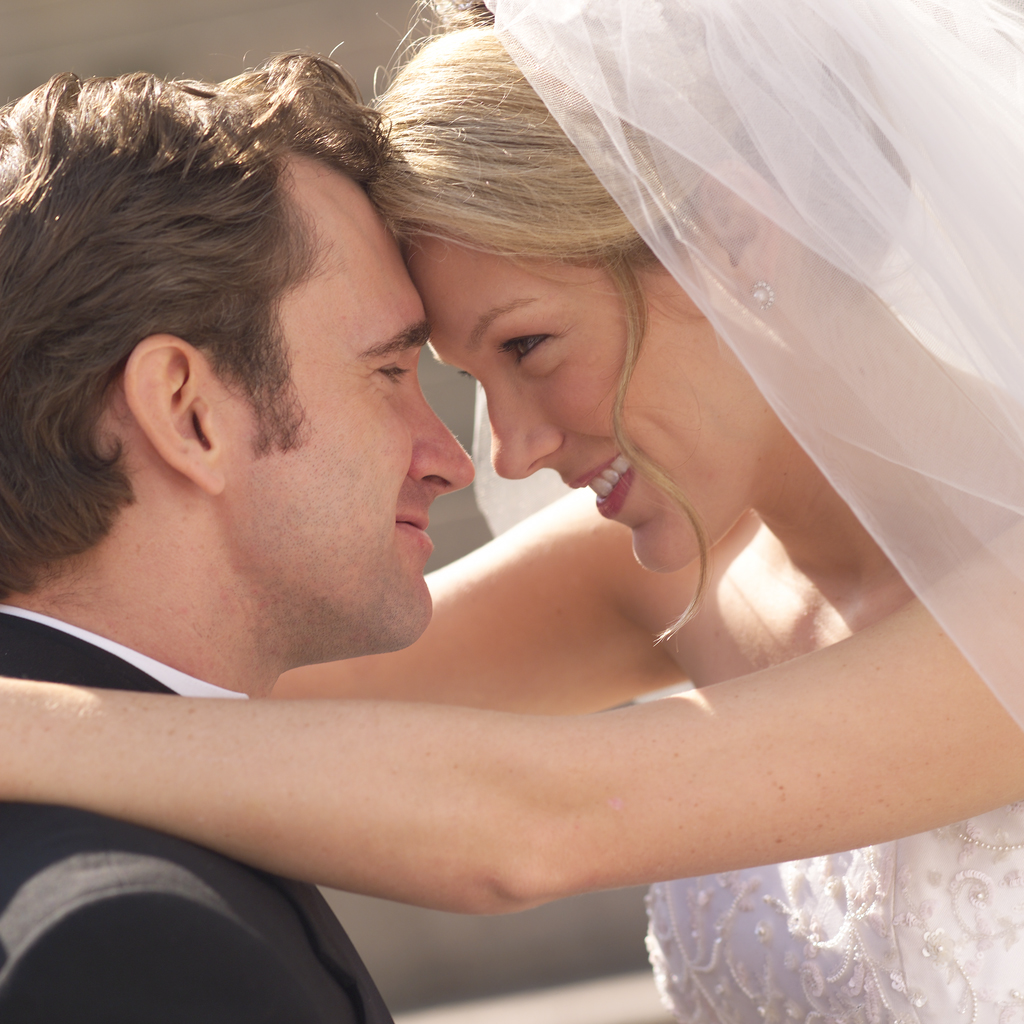
Bell discredits representation (and therefore photography) as true art. Due to its basis in our physical world, it is distracting from the aesthetic emotion experienced through significant form. Though I acknowledge that simply snapping a picture of whatever one sees fit should not constitute as true art, I believe that some photography can definitely have artistic value. Take, for example, a wedding photo. If captured correctly, a very emotional moment can be frozen in time and relived for years to come. One can't argue that love is one of the most intense and "other worldly" human emotion-arguably beyond normal emotions and therefore possibly sublime or a form of aesthetic emotion. Of the thinkers we have studied so far, a common theme of emotion as an integral requisite for art has emerged. If representation can trigger recollection of such a strong emotion, I believe that it definitely has artistic value.

Thursday, February 24, 2011

The Value of Formalism (Response to Sarah)

In Sara's most recent post she writes, "Formalism happens no matter what intention the artist has, hence why it is really the only fair way to judge art first and foremost." I do have to agree wholeheartedly that formalism is perhaps the most direct and objective way of defining art. If we define how lines, colors, and shapes should exist in great art, then determining whether or not something is art would be simple. I must argue, however, that despite Bell's aesthetic emotion strict formalism seems somewhat lacking in the feeling, diversity and creativity that art is so often associated with. How can art be unique if it is independent of content?

Christopher Lotito's addresses this concern and confirms my critique when he writes, "Neither Formalism nor Neo-Formalism is the defining answer to the questions raised in the nature of art. As before, we are left to wonder, what theories will be created and indeed shot down by the philosophy community in relation to the nature of art next?"

A link to Lotito's Essay

Emotion Beyond Our Control (Bell, Significant Form, & Aesthetic Emotion)

Significant form, according to Bell, is common to all art in its formalism. It is not the intention of the artist or the thoughts of the viewer which give art its unique value, but rather the aesthetic emotion which is evoked through the shape, color, and contour of the work. Further defending art’s unique value, Bell distinguished art from normal human experience when he wrote, “Great art remains stable and unobscure because the feelings that it awakens are independent of time and place, because its kingdom is not of this world.” These feelings are art's aesthetic emotion. The problem with aesthetic emotion is that it has yet to be defined. In his attempt at elaborating upon this mysterious feeling, Bell does not expand beyond the circular definition that significant form elicits aesthetic emotion which is the emotion felt from viewing significant form. The two terms are used dependent upon one another, creating a requirement for great art, but not defining characteristics which can exist outside of art.

In considering the power of aesthetic emotion derived from significant form, Bell states that, "The great value of art lies in its ability to shake us out of our everyday lives, to connect us with a deeper reality." My question is, who has access to this deeper reality? Is it the artist's job to create art which captures and intrigues its viewers and therefore forces aesthetic emotion upon them? Or is it the responsibility of the viewer to recognize significant form in order to obtain aesthetic emotion? Bell would argue that the only way to recognize art--and therefore significant form and aesthetic emotion--is to feel it. But how can we recognize an emotion if we have not previously experienced it? Is Bell suggesting that truly great art has a power over us? If it transports us beyond our everyday experiences and emotions, do we have a choice in how we respond to it?

Thursday, February 17, 2011

Childlike Bliss

"One might compare the relation of the ego to the idwith that between a rider and his horse. The horse provides the locomotor energy, and the rider has the prerogative of determining the goal and of guiding the movements of his powerful mount towards it. But all too often in the relations between the ego and the id we find a picture of the less ideal situation in which the rider is obliged to guide his horse in the direction in which it itself wants to go."- Freud
From New Introductory Lectures on Psychoanalysis, 1932.

A debate arose in class on Wednesday about the term "childlike". Sean mentioned that just because a behavior, thought, or piece of art is "childlike" doesn´t necessarily make it bad or regressive. And for that matter, regression doesn´t necessarily have to be bad too. If art takes us back to a state of play in childhood and helps us resolve current issues, I would consider it a good thing. The id is instinctual. It is uninhibited. It contains raw emotion without censorship or repression. The id is perhaps the most honest and pure part of the self; the closest to reality without being clouded by the expectations of the superego and the pride of the ego. Some theorists (including Plato) argue that from birth, we are corrupted by the outside world and that a return to our original selves would be ideal/a path to true happiness. Could this include a return to the purity of the life of the solitary id? With just the id (as in childhood), there are no repercussions, no guilt, no inhibitions, no obligations; just ignorant bliss. Would art ( such as the literature described by Freud) then be a tool and a mean of obtaining this state of mind, purity, and ultimately happiness? Am I reading too far into this? What do YOU think?

Reading into Freud

"The ego is not master in its own house."-Sigmund Freud

Freud´s Theory of the Unconscious suggests that we all have repressed and unresolved childhood conflicts below the surface of our conscious mind. These conflicts, he suggests, stem from a battle between the id (instinctual desires) and the superego (“conscience,” namely, socially-acquired control mechanisms which have been internalized, and which are usually imparted in the first instance by the parents"), forming the ego. The ego is accessible in the preconscious while the superego and the id are not. However, these three parts of the mind make up the self and can explain how our minds work and therefore how and why we behave the way we do. How then, does art come into play? Freud addresses the writer as somewhat of a speaker for us all. Literature, he says, is a form of catharsis for the writer in that it represents childhood play and memories. For the reader, literature is device in which "we can enjoy our own day-dreams without reproach or shame". Consistent with Freud´s outlook on gender differences, a female can enjoy erotic literature and a male can enjoy aggressive literature, behaviors which are stereotyped and disapproved by society, without feeling guilty and without affecting the outside world. Are we conscious of this catharsis? Does reading bring us into a different world? A world which our id desires to live in but is denied by the superego. In this manner, Freudian psychology helps explain why we create art (in the form of literature), but does it account for a definition of what art actually IS? Is that too something beyond our grasp and hidden in the unconscious?

Friday, February 11, 2011

Response to Gina

In her blog, Gina asked: So is all advertising bad in its manipulation? Are their any campaigns whose consumer control is actually a valuable employment of artistic communication? In my opinion, advertisement extends beyond art. Yes, maybe an add/campaign does influence the consumer and convey the emotions intended by marketing companies; but the intentions behind these adds do not stop with conveying a feeling. The motive for making consumers feel is to persuade them into buying a specific product and therefore financially benefits the company. Despite the emotional messages that may be portrayed, is the consumer actually learning anything? Does the consumer become a better person from feeling these emotions or buying this product? Perhaps, but if so, this process is definitely not directly due to the campaign; it is indirectly linked-- in a subjective manner-- to the emotions marketers attempt to control. So are there campaigns with artistic value of communication? I would have to say no. The emotion isn´t raw; it isn´t conveyed with moral intentions. The communication between companies and consumers is not indicative of sharing human experience; it is rooted in the fiscal. Perhaps some advertisements appear artistic, but I find it difficult to argue that their communicative qualities are solely to inspire or benefit the consumer without also financially--and therefore, selfishly and pleasurably--benefiting the creator.