A complimentary video to Claxton and Taylor´s essays.
¨Many people believe that creativity is something you either have or you don't, and if you are amongst the happy few, you'll use your creativity to create difficult art the general public won't understand but your creative counterparts will love.
But; creativity is of vital importance to every act you'll ever do. Art or no art. The usage of your creativity can change every action you'll ever do from ordinary to extraordinary.¨
Thursday, April 28, 2011

Saturday, April 23, 2011
Participation Art
Participation Art
The link above is an example of participation art at SFMOMA. "Visitors in the exhibition "The Art of Participation: 1950 to Now" at SFMOMA (November 8, 2008 - February 8, 2009). Looking back nearly 60 years across a wide spectrum of genres and media, this exhibition examined how artists have engaged members of the public as essential collaborators in the art-making process."
If anyone can be a part of it, how is this art "unique"?
Piper might argue that since humans are experiencing/participating in it, that is exactly WHY it is unique: no two will experience it the same way.
What do you think?
The link above is an example of participation art at SFMOMA. "Visitors in the exhibition "The Art of Participation: 1950 to Now" at SFMOMA (November 8, 2008 - February 8, 2009). Looking back nearly 60 years across a wide spectrum of genres and media, this exhibition examined how artists have engaged members of the public as essential collaborators in the art-making process."
If anyone can be a part of it, how is this art "unique"?
Piper might argue that since humans are experiencing/participating in it, that is exactly WHY it is unique: no two will experience it the same way.
What do you think?
Black Swan Theory (inspired by Piper's mystery of the object)

A link to an essay on "Black Swan Theory"
When discussing Piper's view of performance art as unique, we mentioned that no two performers are the same regardless of how similar their technique is. The film "Black Swan" is about a dancer who must play two conflicting roles on stage. The roles begin to affect her waking life and the conflict eventually results in psychosis. The excerpt from Psychology Today suggests that humans naturally attribute order and predictability to every day events... "Because it is always comforting (and often useful, in fact) to believe that the world is a safe, predictable place. It feels good to be overly optimistic and to feel in control of one's destiny, and that everyone else is in control of his or her destiny. That if I do a,b, and c then x,y, and z will result. But if we take this comforting and illusory form of thinking overboard by under-representing uncertainty in our efforts to predict the future, we leave ourselves vulnerable to the jarring peck of the black swan." Perhaps this is what Piper means by the 'mystery of the object'. Objects are predictable. They have qualities that we expect to experience. Attributing magical powers and the ability to move us to objects, according to Piper, is naive. People, on the other hand, are far beyond predictable. Despite our more or less 'concrete' (or at least impeccably slowly changing) personalities, we are complex and ever-changing. Our actions often seem impulsive and illogical. Our personal creations--our ART--are symbolic and unique. Perhaps, as Piper suggests, the uniqueness of mankind is what makes performance art not only unique, but irreplaceable as well.
Tuesday, April 12, 2011
When Did This Become Art?
Although I don't agree with absolutely everything Rooney says, he makes a few good points in this video, asking "Does every space have to be filled with something?". What happened to simplicity?
Final Thoughts on Dickie
Perhaps the most blatant conclusion to be drawn from Dickie concerns his failure to objectively define art--a problem which we keep returning to. According to Dickie, it is not inherent properties, but a relational property within the artworld that makes an object art. These relational properties elicit conferred status and then an "objective definition" is possible but doesn't often emerge. Although Dickie seems confident in declaring almost ANYTHING as a candidate for appreciation as long as it has conferred status, I am not quite as comfortable in doing so. His view appears extremely inclusive and almost demoting to true art and artists, suggesting that uniqueness and merit and independent of status in a world that anyone can be a part of. I've come to realize recently that a number of theorists (on the subject of art and of other subjects) tend to use language for reasons beyond persuasion. The circularity that we have encountered in many class discussions is due largely to language rather than theory. While it is frustrating to accept our limitations as humans, I do think that it is also necessary to realize that even the greatest of thinkers can't always articulate flawless theories. Dickie, among others, writes in a manner that seems to deny failure, but in reality he is repeating himself and not getting very far. Isn't the aim of philosophy to ask more questions? Does anyone else think that we have become so focused on "What is art" and "What is art's unique value" that it is possible that we are missing other questions?...Such as, WHY is there no single answer to these questions?Maybe then, we could answer them better.
Thursday, April 7, 2011
Response to Kim
In her last post, Kim asks, How does or should Danto deal with conflicting, legitimate art theories? Arguably, Danto writes somewhat circularly and doesn't quite define art. Although Danto acknowledges that one must have knowledge of the history and theory of art in order to understand and appreciate it (a central part of his own theory), he doesn't come up with any objective standards upon which we could begin to define art. Perhaps this is because of his emphasis on value rather than physical properties; evaluation rather than description. But what frustrates me is Danto's lack of concrete examples. Theories of art are different, I acknowledge. But they must contain some common quality, otherwise I feel that Danto's "is" may be too general and too inclusive. Knowledge and history are necessary in order to understand almost anything, I agree, but they are such broad concepts that I wonder how accurate one can be while using them to define rather than evaluate. In class, we determined that sometimes it is not the object that has artistic qualities, but the language that describes it (although the object can render such qualities). While in theory, this all makes sense to me, I can't help but confess that the redundancy which occurs when discussing the value of art always seems to overshadow and distract from our unanswered (or at least more complex) question of "What is art?".
Monday, April 4, 2011
What Is, Isn't
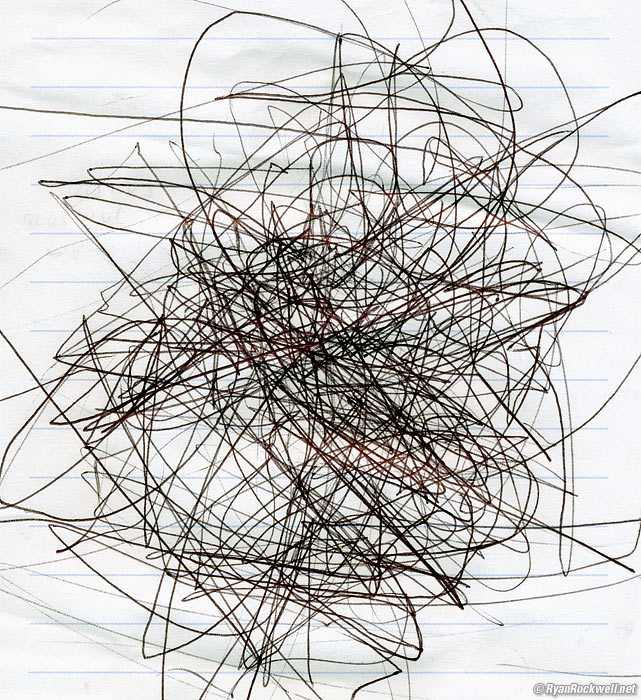 "It is one of the commonest of mistakes to consider that the limit of our power of perception is also the limit of all there is to perceieve."-C.W. Leadbeater
The is of artistic identification, according to Danto, is a privilege to understand. As mentioned in class today, experience is an integral part of acquiring and maintaining the ability to understand (and therefore define) art. This idea also traces back to symbolism. Without experience beyond scribbles, an individual cannot see the picture in this post as anything but scribbles. However, a viewer who has been through emotional turmoil may see it as a representation of the confusion, anger, or sadness they once experienced or as a a cathartic process geared toward personal progression and development beyond a situation or emotion. To an extent, this view is highly subjective, suggesting that a work of art could mean almost anything to anyone depending on their past experience. With deeper consideration, however, I wonder if the above quote can be applied. Does every piece of art have the ability to elicit many perceptions based on the viewer? Can art encompass multiple qualities, some of which can only be seen by the "educated", "experienced" or perceptually aware? Is the is of artistic identification a set point? Or is it what it is to who is experiencing it?
Saturday, April 2, 2011
Response to Gina's post (Dewey's Dinnerware)
In Gina's most recent post, she poses a question: "Likely all would agree that the fancy tableware is art while on display on the shelf or in the cabinet, but does it decline in artistic stance when it gains in practical (yet still just as artistically beautiful for, the piece itself doesn't change) importance while presenting food upon the table?" This question reiterates focus on the intentionality theory. As I would normally argue with Goodman that "when" art occurs is the most important aspect when considering objects, I feel that many found artifacts, "fancy" dinnerware, or handcrafted furniture could have dual definitions-- that is to say that they could be art while at the same time serving a practical purpose. There is a difference between a white china plate and one with intricate designs. There is a difference between a leather couch and a set of furniture placed strategically in a feng shui pattern. I think that some craftspeople may want to construct something for more than just making a tool-they want to put a bit of themselves into it, therefore, arguably making them artists. Can an object be a piece of art and a tool simultaneously?
Subscribe to:
Comments (Atom)