Thursday, March 31, 2011

The Language of Art

-Goodman's Aesthetic Theory-

The link above provides a more detailed account of Goodman's view on representation, referring to "cognitivism – that is, because we discover and even create the worlds we live in through our
interaction with symbols, our interest in those symbols is manifestly cognitive." I think that--somewhat ironically--Goodman's accounts of language and symbolism when referring to art, serve to explain why he shies away from giving a definition of the properties that art must contain, avoiding the question through wordplay and through symbolism itself. Language is an integral part of both the complications and the solutions behind defining art (as it is when considering any field philosophically). When a dreamer hears the word "blue", he may think of the sky on a summer day. When a sailor hears the word "blue", he may think of the ocean. And when a musician hears that same word, perhaps he thinks of sadness or calmness or a favorite shirt. While "The Scream" (Edvard Munch) "literally exemplifies swirling shapes, lurid colors, dramatic contrasts, and powerful brushwork. It metaphorically exemplifies – that is,
it expresses – feelings of anguish and alienation". Without language, could pieces of art exemplify feelings in the way that Goodman suggests is necessary? Does significant form elicit emotion or does it exemplify other significant forms? Can we truly express what a painting exemplifies when words refer to common objects for us all, but not necessarily common emotion?

Tuesday, March 29, 2011

Temporal Tricks


Don't bother about being modern. Unfortunately it is the one thing that, whatever you do, you cannot avoid.
- Salvador Dali


For art to be pure, Goodman argues that it must fit its context. Is Dali correct in insinuating that there is no time but the present? Should art therefore be interpreted based on its immediate surroundings and context, thus adhering to Goodman's uses theory and therefore allowing art to trigger thoughts in relation to current context? Wouldn't this view then violate Goodman's purist view that it is not the properties outside of a piece of art that make it real, but rather its intrinsic and unique properties? But how can such properties exist? How is anything not representation? Every shape, color and line will somehow trigger thoughts within the evolved human mind. Regardless of whether or not we try to see the art for its form, will we ever be able to see beyond the "distractions" of current context, personal history/experience, and possible future interpretations? In my mind, the answer is "no". The present is shaped by the past but as humans, we often cannot help keeping our own contextual and cultural influences in mind when experiencing a piece of art. Perhaps we should just listen to Dali and take art for what it is now and not what it was or could be.

Saturday, March 26, 2011

(Response to Alex)

In Alex's most recent post, he writes:

..."to have an objective view to which we can all agree on the truth that it lays out for us to which we can begin our subjective dismantling of it as a whole.

If the entirety of art can be categorized into similarities in the same fashion that programs such as "pandora" or "genius" lay out music, then we would have a basis to which we can display our different taste and interests in art. What one person considers art does not necessarily need to agree with anyone else's in this layout..."

While I agree that we must consider both the collective objective view AND the subjective taste when considering the value of a piece of art, I am reluctant to accept the proposition that what one person considers art does not need to agree with another's simply because of taste differences. I still think that a concrete objective standard should be decided upon regardless of taste. Just because someone doesn't like something, doesn't mean that they should not be able to appreciate its classification as art (ie: a classical pianist should not deny the art of Lady Gaga's music even though he would prefer Mozart).

Wednesday, March 23, 2011

We Create Our Understanding


Intuitions without concepts are blind-
Immanuel Kant


A link to the theories of Kant and Hume.


While Hume does theorize about the subject-object relation, I wasn't quite sure of how to express it until stumbling across the link above, describing Kant's philosophy which, to me, is 100% logical and perhaps the most convincing argument I've heard for--not against--the relationship between subject and object. Hume and Kant are often mentioned simultaneously and I was inclined to further research Kant's philosophies. Building upon the gaps in Hume's works, Kant sought to use our immediate sensory experiences to explain our judgments on the outside world. Kant believed that we use concepts to make sense of our intuitions (our sensory experiences). The power of concepts, he believed, led to an understanding of objects and of the self. Furthermore, this understanding leads to the formation of rules by which we define and interpret our sensory experiences. Just as sensory experiences alone cannot be understood without conceptualizing them, rules without concepts are useless. This balance, or (in Kant's words) synthesis, is affected by our own judgment and natural inclination to try to understand the properties of and our relation to objects. We cannot judge without already having submitted to some rule regarding both the object and the concept.

If we consider these ideas, then we can better understand how we need both subjectivity and objectivity in the art world. For a painting, our immediate sensory experience is vision. Upon viewing a painting, Kant would imply that we would form a judgment based upon a somewhat unspoken rule (derived from and submitted to concepts which we have previously experienced and contemplated). Once this judgment was made, an understanding of the painting is possible. Essentially, we create our own understanding of the world around us.--ie. a piece of art. What follows, then, is the question of how to arrive at a universal judgment of the piece--and we arrive back at the antinomy with which we began Hume's chapter. Perhaps there is a commonality within the rules upon which we make judgments that constitutes as universal so that we may judge artwork objectively and subjectively at the same time. What do you all think?

Monday, March 21, 2011

Buddha's Skepticism


Buddha's quote (above) on skepticism could very well describe Hume's antinomy regarding art. On one hand, we (naturally) seek an objective definition of art and its goodness. A universal standard must exist-to some extent- in order to label something as art. On the other hand, the words your own suggest some degree subjectivity based upon experience--from which this reason and common sense are derived. In other words, there we must know what we are looking for but the only way that we will find it is through experience. Moreover, what one considers good art is further determined through individual taste based upon both subjective (past and present) experience and a universally accepted objective agreement. While both skeptics and empiricists are weary of anything which cannot be observed (ie. the "cause" of snow as discussed in class), I do agree with what we have discussed throughout the semester: that the objective cannot exist without a subject to observe it and the subjective would not exist without something objective to trigger taste. Is it all circular?

Saturday, March 12, 2011

Define Forever

How do we define something as open as infinity? Or art? While I enjoy bringing together our discussions into a singular formula, a "definition"--which by definition is concrete--of art might simply be ever-changing. Just as the times, society, materials, and theories change, so too does art. How then, can we have a definition that is closed off? In this manner, I am in accordance with Weitz and acknowledge the impossibility of finding a concrete definition of art.

Wednesday, March 9, 2011

Of the Celestial and the Mundane


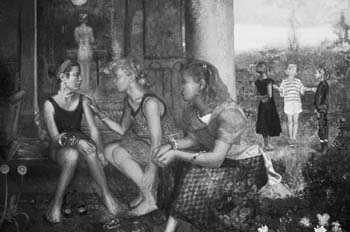
"Mythic Master: Painter Frank Galuszka constructs images of the celestial and the mundane, of excess and sacrifice, with the techniques of Renaissance masters--that is, if he chooses to. "

The description of Galuszka's work in the link above uncovers why his work is the way it is. He has Renaissance training which he uses only when he wants to. At the same time, as demonstrated quite articulately in "Junk", Galuska is "A juggler of the celestial and the mundane, of excess and sacrifice". He can depict the mundane (junk or a run-down porch in Philadelphia) as celestial (riches or a heavenly and glowing scene). Whether it is the optimist in Frank or his extensive training and life experience, he moves "confidently from mythic reason to explosive abstraction". It was mentioned in class today while discussing Weitz that a definition should be eternal, but with times changing and art in turn adapting to the world, how can a true definition be possible? Perhaps artists lie Galszka could provide an answer to this question. As Professor Johnson said, he doesn't change is environment, he changes how he is in his environment--depicting the world both as it is (and finding its beauty) and how we sometimes wish it could be. I'm not completely sure about an exact definition--including necessary and jointly sufficient conditions--for art, but surely Galuszka's ability to represent and create simultaneously while finding beauty in the mundane, must be included in the definition of a true artist.

Thursday, March 3, 2011

Tolstoy vs. Dewey (Response to Johnathan Logan)

In a recent post, Johnathan wrote, "... it is fairly safe to assume that any given aesthetic experience cannot be considered fully without all the participants of that experience - that is: the subjects, the times, the places, the actions, the reactions, etc. It is in this way that art, for both creator and audience, is a continuation of their respective experiences." Looking to this quotation, I realize that what Dewey differentiates as an experience from experience in its ordinary form is dependent upon much more than the material, the creator, and the observer. Context as a continuation provide an opportunity for something to become an aesthetic experience. Using the example from class, driving a car down a highway might, for one person, be second nature--experience. Driving down the same highway, however, may very well constitute as an experience (and therefore aesthetic artistic) for another individual due to the content of a conversation they have with a friend sitting beside them in the passenger seat about, for example--the curve of the road or the foliage on the trees may trigger a childhood memory which makes the viewer appreciative of the scenery, and THIS may be considered an aesthetic experience. Does Dewey's extreme subjectivity in regard to art suggest that every experience and every object has the POTENTIAL to elicit aesthetic emotion?

Wednesday, March 2, 2011

Dewey & Animal Communication


Professor Johnson mentioned the relatively unknown intelligence of birds like the crow and I was moved to further explore this claim. I found this link, in which Dr. Chris Bird acknowledges the problem solving abilities of the crow- an animal often overlooked in terms of intelligence-in raising water level in order to obtain food. It is clear that animals are not machines that reproduce, eat, and die, but to what extend do we still underestimate their capabilities? Elephants can paint, chimps can imitate, dolphins can perform, birds can mock (and possibly understand) speech. So how can one deny animals' capabilities to produce art-a product emerging from, as Dewey points out, natural experience-when they are perhaps the most emerged in "natural" environments and predicaments?