Thursday, January 27, 2011

Is It Really All in How You Look At It? (Response to Kate)


What do you see? Does the paper read "Opportunity is nowhere"? Are you in a bad mood? Are you a pessimist? Does it read "Opportunity is now here"? Are you feeling particularly happy? Are you an optimist? Is our definition of something relative and "all in how we look at it"? On the topic of art, I beg to differ.

In a recent entry, Kate asked: Does perception effect what is or isn´t art, or are there distinct limits regardless of personal feelings? We touched upon the subjective/objective debate in class. One cannot deny the subjectivity of art. Some people like abstract paintings while others like impressionist paintings. Some listen to heavy metal while others prefer classical violin and piano. Some would rather dance ballet en pointe while others enjoy the style of hip hop. In response to Kate´s question, no, I do not believe that perception effects what art is or isn´t. The entire reason behind taking a philosophical approach to art is to define the common qualities within art that make it unique. That is not to say, however, that personal taste is irrelevant in liking or disliking art. It just means that certain subjective responses must be put aside when attempting to objectively define something as art.

Tuesday, January 25, 2011

Intent and Observation


We all know that Art is not truth. Art is a lie that makes us realize truth, at least the truth that is given us to understand. The artist must know the manner whereby to convince others of the truthfulness of his lies. ~Pablo Picasso

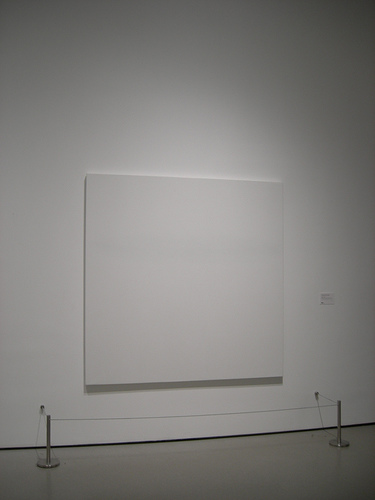
In class we briefly mentioned the intent of the artist when creating a work of art. From this view, art is created on purpose. For what reason? Most artists create with the hopes of portraying some sort of message. To whom? In Wartenberg´s introduction (in which the play "Art" is described), Serge acknowledges the different tastes that his two friends have for the same white canvas with diagonal lines. One appreciates the intent and organization of the piece while the other does not consider it art. Since Wartenberg acknowledges the differences in taste, is art subjective? I can´t be. The philosophical approach to art seeks to define it objectively. The subjective/objective debate over art has been pondered by great thinkers like Kant and Hume. Interpretation (subjectivity) is essential in the artworld as a way to absorb what has been created. Every painting, musical or dance performance, book, poem, or sculpture needs an audience. How then, do we objectively define what art is if we acknowledge that each viewer has his or her own "taste"? Are only the opinions of the art experts valid? Is there perhaps a difference between liking something and considering it art? What is that difference and who determines where it begins and ends?